Most founders treat LinkedIn like a resume that occasionally gets updated. The ones who actually build pipeline from it treat it like infrastructure.
This guide walks through the content system, profile setup, and DM sequence that turns a LinkedIn profile into a working lead generation engine. No outbound lists, no paid ads. Just consistent, visible work that earns trust before you are ever on a call.
Why LinkedIn Still Wins for B2B Pipeline
LinkedIn is the one channel where your buyer shows up already in a decision-making mindset. Nobody opens LinkedIn to switch off the way they open Instagram or TikTok. That context changes how content gets read and how fast trust builds.
Industry data has consistently shown that around 80 percent of B2B leads sourced from social media come from LinkedIn, not Twitter, Instagram, or Facebook combined. That figure has held up across multiple independent studies over the years. LinkedIn is not one channel among several worth splitting attention across. For B2B, it is the channel.
There is also a supply and demand gap most founders miss. Only a small fraction of LinkedIn users post consistently, so the competition for attention in your buyer's feed is lower than it looks. Inbound leads also tend to close faster, because the buyer arrives with context instead of arriving cold. And unlike outbound, where every message makes the next one slightly harder to land, a body of consistent content compounds. Old posts keep working long after you hit publish.
Building a dependable B2B revenue pipeline comes down to treating LinkedIn as core business infrastructure rather than a place to post casual updates.
The Content Mix That Actually Books Calls
Four types of content do almost all of the work:
- **Teaching posts (roughly 30 percent):** Give away something specific enough that someone could act on it in the next day. If a reader cannot do anything with the post, it has not done its job.
- **Personal posts (roughly 20 percent):** The story behind the work, told in a way that ties back to who you help. Enough to be human, not so much it turns into a diary entry. If a post could have been written by anyone, it is not doing its job.
- **Authority posts (roughly 40 percent):** Your take on where the industry is headed, frameworks you have built, and results you can point to. This is what convinces someone who already knows they have the problem that you are the person to trust with it.
- **Proof posts (roughly 10 percent):** Before-and-after results with real numbers. The more specific the situation, the better. A post about one narrow type of client attracts exactly that client and nobody else, which is the point.
Content You Should Never Post
- Generic advice with no numbers, no steps, and no outcome attached.
- Polls. They have stopped producing leads across the accounts we track.
- Motivational quotes. They collect likes from people who were never going to buy.
- Life updates with no line back to who you help.
- AI-generated copy with no editing. It is easy to spot and it costs trust the moment someone notices.
Building a Profile That Actually Converts
A great content system sending traffic to a weak profile is wasted reach, so this has to be live before you publish anything.

- **Headline:** Lead with who you help, not your job title. The first few words of your headline show up every time you comment on someone else's post. "Founder at [Company]" tells a stranger nothing. Naming who you help and what you help them do tells them everything in half a second.
- **Custom button:** Point high-intent visitors straight to a booking link or landing page.
- **Photo:** A real face, good lighting, plain background. No AI-generated headshots, no logo standing in for a face.
- **About section:** Name the audience, name the pain, explain what you realized that led to your approach, name the mechanism, show results, and close with a single-word DM call to action. Skip links here; they are not clickable in that section anyway.
- **Banner:** State the outcome you help people get, the mechanism, and a rough timeframe. Client logos help if you have them.
- **Featured section:** This is for the visitor who scrolled your whole profile and still is not ready to book. Case studies and a lead magnet give them a lower-commitment next step.
Two mistakes undo all of this fast: posting from a company page instead of a personal one (people buy from people, not logos), and treating LinkedIn as a broadcast channel with no DM strategy, no landing page, and no next step for someone who is ready to act.
You do not have to build this alone. BNC is a working network for founders, built for exactly this kind of execution: growth, operations, hiring, and the people who actually answer when you are stuck. [Join BNC](/membership).
Lead Magnets That Turn Comments Into Leads
- **CTA:** One word, easy to spell. Comment it and it lands in their DMs.
- **Effort signal:** Mention what it took to build. "This took me a weekend to put together" works better than nothing.
- **Image:** A screenshot that proves the hook is real: a dashboard, a booked calendar, or a preview of the resource itself. Posts without proof underperform badly.
- **Hook:** State your authority, the specific outcome, and the timeframe in one line.
- **Framing:** Position it as something you would normally reserve for paying clients.
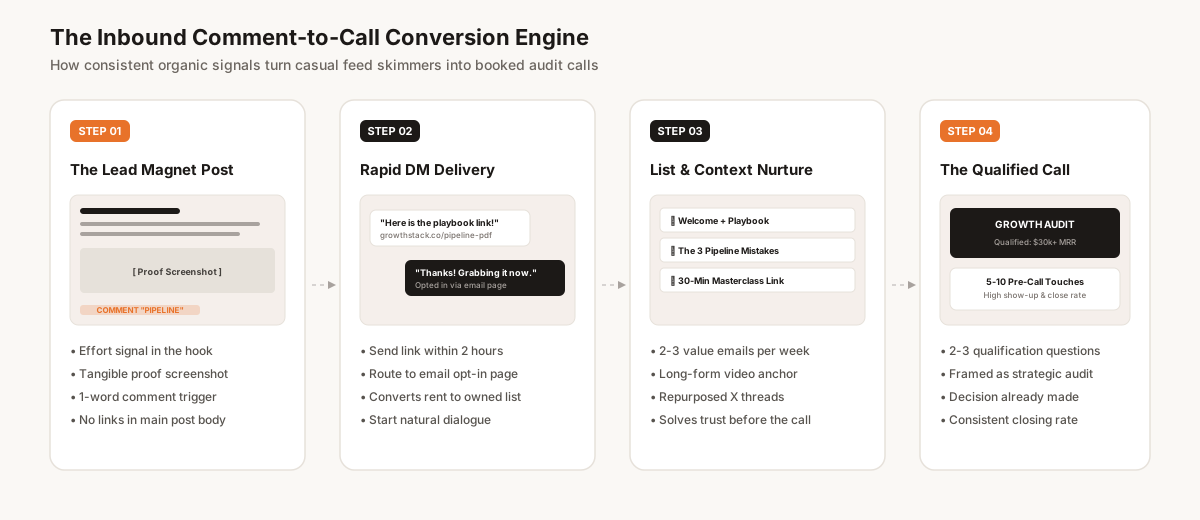
Never put a link in the body of the post. The comment is the entire distribution mechanism, and every comment signals the algorithm to keep the post moving. Reply within a couple of hours or the momentum dies. Gate the resource behind an opt-in page so the lead becomes yours, not just a number on someone else's platform.
Owning the List
LinkedIn is a rented audience. Every lead magnet should route to an email opt-in so the relationship survives an algorithm change or a platform outage. A strong lead magnet can bring in hundreds of subscribers in a single day.
From there: two or three value emails a week, one direct offer email, and a welcome sequence that delivers the resource, tells your story, gives one actionable step, shows a result, and makes the invite clear. Every channel should point to the next one. Posts point to video, video points to the list, the list points back to the next post.
Turning DMs Into Booked Calls
Between booking and the call, send five to ten light touchpoints: a reminder that sounds human, a short case study, an FAQ, or anything that keeps the person warm. The goal is for the call to confirm a decision that is basically already made, not to make the case from scratch.
Before anyone hits your calendar, filter with two or three qualifying questions: current revenue range, biggest challenge, website or profile link. A few minutes of homework before the call beats twenty minutes of it wasted figuring things out live.
Frame every call around what the prospect walks away with, not around being sold to. An "audit call" or a "setup call" converts better than a "discovery call," because it tells the prospect exactly what they get from showing up.
Tracking What is Actually Converting
Posting without tracking is just guessing with better lighting. A handful of numbers tell you everything: how many comments a post pulls, what percentage of commenters turn into a DM conversation, what percentage of those DMs turn into a booked call, and what percentage of booked calls actually show up and close.
A simple spreadsheet does the job. One row per post: date, content type, comments, DMs started, calls booked, calls closed. Nothing complicated, no dashboard needed.
Review it weekly, not daily. Daily numbers move too much to mean anything. Weekly, patterns show up fast: which content type actually books calls, which lead magnet pulls the most DMs, which qualifying question filters out the wrong people before they waste your time.
The instinct is to keep posting whatever gets the most likes. Likes do not pay the bills. Booked calls do. Track the number that actually matters and let it decide what you keep doing.
Turning One Post Into a Week of Content
Longer-form video, twenty-five to forty minutes, becomes the anchor at the bottom of the funnel. Nothing builds trust as fast as watching someone talk through their thinking for half an hour. Everything else should eventually point back to it.
Every LinkedIn post can also become an X post in minutes: shorter sentences, hard line breaks, lowercase, a more direct tone. Content that feels slightly too sharp for LinkedIn often lands well on X. Ten strong LinkedIn posts, repurposed, becomes thirty pieces of X content - two to four weeks covered with zero new ideas. Post more frequently on X than on LinkedIn; the platform rewards volume differently.
Scaling Beyond Your Own Profile
A different face resonates with a different slice of the same audience, even posting near-identical ideas. Change a word and an image per post and the platform will not penalize the repeat.
Wait until your own account is producing consistent DMs before adding more voices. Once it is, bring in other people from the business: operators, client-facing team members, whoever is closest to the work. Same content system, angled slightly differently per person.
The 90-Day Rollout
- **Week 1:** Build the profile, set up a booking link with qualifying questions, and put your content system in place.
- **Week 2:** Comment daily with specific insight, not generic agreement. Send targeted connection requests. Publish your first lead magnet. Start posting daily.
- **Weeks 3 to 4:** Run every content type, track what converts, start repurposing to X, and begin the pre-call sequence for warm leads.
- **Month 2:** Cut what is not working, double down on what is, start the email list if you are seeing traction, and record your first long-form video.
- **Month 3:** Bring in team accounts, publish the anchor video, review the full 90 days, and plan the next one.
Building this is faster with the right people around you. BNC exists for founders doing exactly this kind of work: comparing notes, holding each other to it, and sharing what is actually converting in real time. [Join BNC](/membership).
Related Posts
- [Opportunity Debt: What Happens When You Stop Showing Up](/blog/cost-building-business-without-right-people)
- [The Relationship Flywheel: How Consistent Founders Compound Their Network](/blog/your-network-should-create-opportunities-not-just-connections)
- [Founder Isolation Is Costing You More Deals Than You Think](/blog/founder-isolation-business-risk)
---
Jason Barrett is the founder of BNC, the global network for people building businesses. He is a former Head of Digital at McCann London with credits including Microsoft, Nike and Apple. He has generated over $5.5 million in revenue through organic social systems for 400+ businesses. Jason built and sold TwitJobs in 2009 and is a Lovie Awards judge. Join the BNC community at [businessnetworking.club](/membership).